AI Advances Challenge Mathematical Problem Generation Rates
Prominent mathematician Terence Tao highlights a growing concern regarding the pace at which artificial intelligence systems are capable of solving complex mathematical problems, potentially outstripping the rate at which new, challenging problems can be formulated by human researchers. This development raises questions about the future landscape of mathematical discovery and research.
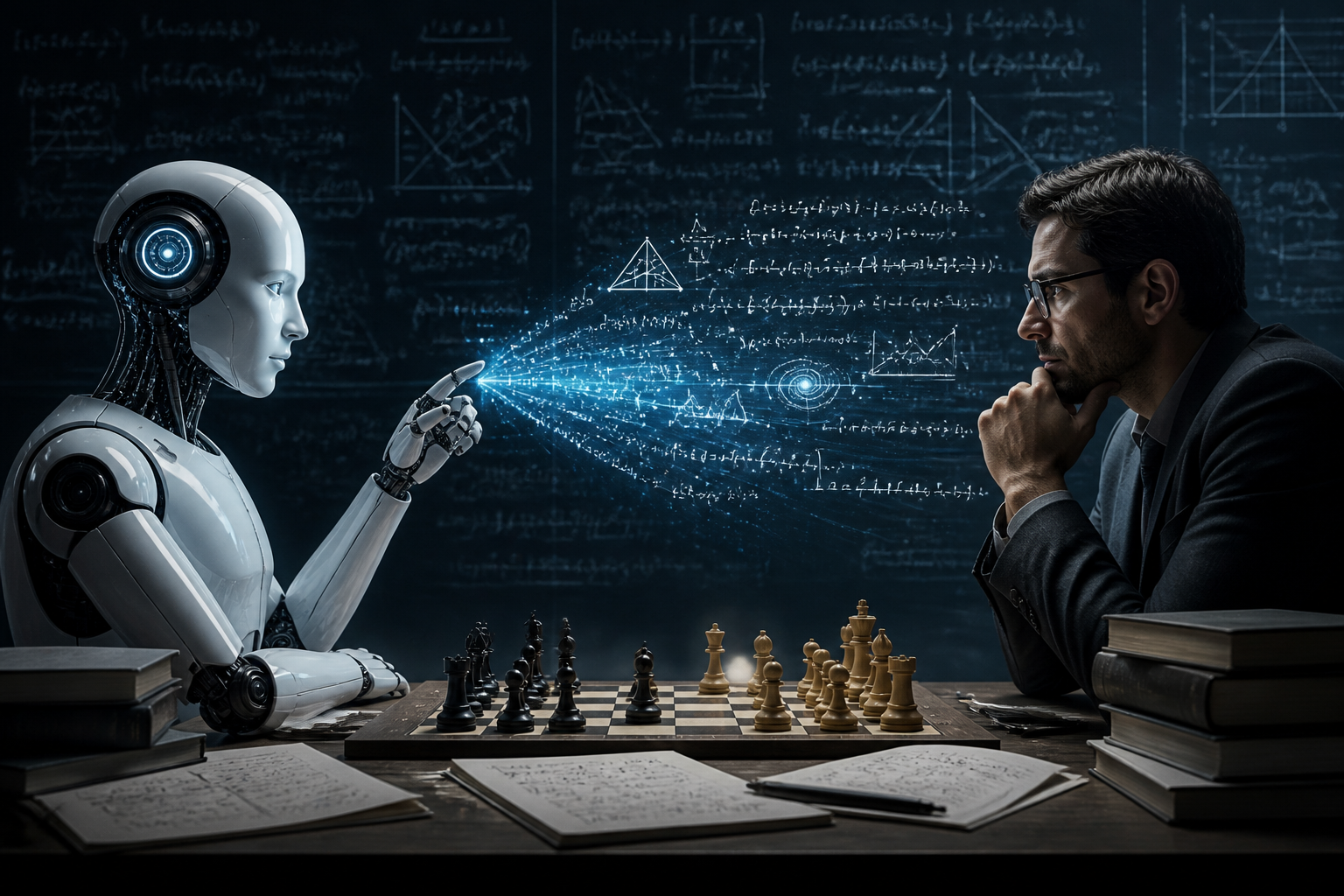
Terence Tao, a distinguished mathematician and Fields Medal recipient, has articulated a significant observation concerning the accelerating capabilities of artificial intelligence within the realm of mathematics. His commentary suggests a potential imbalance where AI systems are now able to resolve highly intricate mathematical challenges with increasing speed, possibly surpassing the human capacity to conceptualize and develop new, equally complex problems.
The Pace of Discovery
This trend points to a shift in the traditional dynamics of mathematical research. Historically, the pursuit of solutions to difficult, unsolved problems has driven much of the field's progress. However, as AI tools become more sophisticated, their ability to dissect and provide answers to problems that might otherwise occupy human mathematicians for years or even decades is becoming evident. This raises questions about the long-term implications for how mathematical breakthroughs are achieved and what role human intuition and creativity will play.
AI in Action
The advancements in AI are not merely theoretical; examples from leading AI research laboratories, such as OpenAI and Anthropic, reportedly illustrate this rapid problem-solving prowess. These entities are at the forefront of developing large language models and other AI architectures that exhibit advanced reasoning capabilities. The specific applications within mathematics are diverse, ranging from proving theorems to discovering new patterns and relationships that might elude conventional analytical methods.
Implications for Research
Professor Tao's observations underscore a critical juncture for the mathematical community. If AI systems can indeed "flatten" or rapidly solve hard problems almost as soon as they are posed, it could necessitate a re-evaluation of research methodologies and educational paradigms. The focus might shift from rote problem-solving to more abstract or foundational explorations, or towards the development of novel problems that are inherently resistant to current AI approaches.
Furthermore, this rapid advancement could also open new avenues for collaboration between human mathematicians and AI. Instead of viewing AI purely as a competitor, it could be leveraged as a powerful assistant, augmenting human cognitive abilities to tackle problems of even greater complexity, or to explore vast mathematical landscapes more efficiently.
Looking Ahead
The dialogue initiated by Professor Tao highlights an ongoing evolution in the relationship between technology and fundamental science. It prompts contemplation on how mathematical innovation will proceed in an era where artificial intelligence can contribute significantly to the resolution of problems, potentially altering the very definition of a "hard problem" in mathematics.
Source: AI Is Solving Math's Best Problems Faster Than They Can Be Replaced, Terence Tao Warns — Decrypt. This article was rewritten by AI; please visit the original publisher for the source reporting.
Comments (0)
Sign in to leave a comment.